
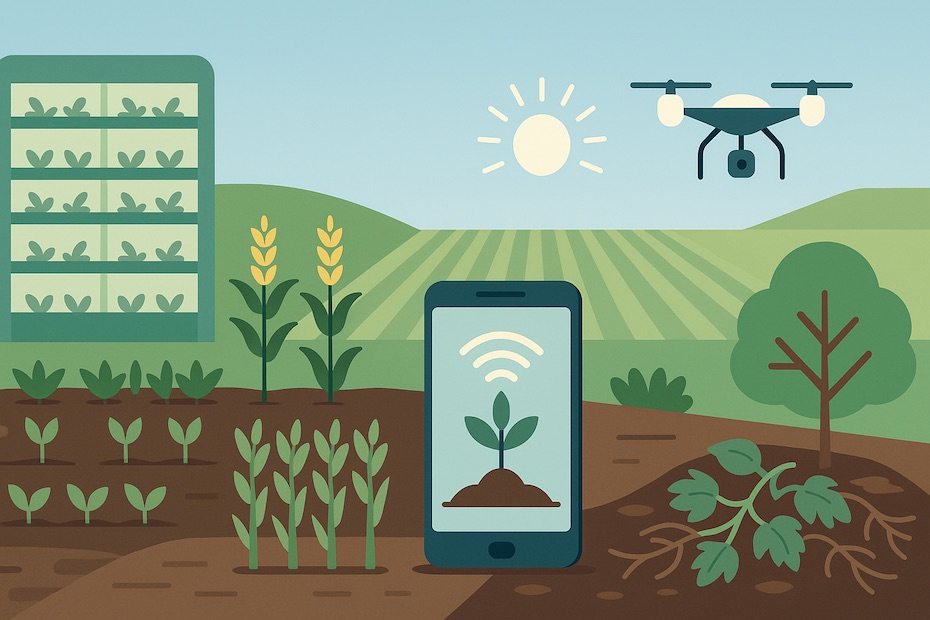
Feeding 10 billion people sustainably requires radical changes in agricultural productivity, climate-smart practices, and food system efficiency. Breakthroughs in biotechnology, digital agriculture, and regenerative models are no longer optional—they are foundational.
This article equips you to evaluate the most impactful innovations shaping the future of food. You’ll examine the real-world value of precision farming, AI-based crop modeling, vertical agriculture, and more—all from the perspective of a veteran guiding investment in scalable, sustainable agribusiness.
What Are the Main Agricultural Challenges in Feeding 10 Billion?
Feeding 10 billion people will strain land, water, and climate systems already under pressure. You must plan for yield gains that outperform traditional models while managing sustainability metrics tied to global compliance.
According to the FAO, global food demand will rise by 60% by 2050. Meanwhile, arable land per capita is declining, and more than 70% of freshwater is already allocated to agriculture. Climate volatility—from prolonged droughts to erratic flooding—reduces crop reliability. The pressure is mounting not only to produce more but to produce smarter. You can’t scale yield through expansion alone; resource efficiency must rise in tandem.
Compounding this, consumer behavior is shifting. Demand for certified, traceable, and low-carbon food sources is reshaping what success looks like across the agricultural value chain.
How Can Precision Agriculture Help Boost Food Production?
Precision agriculture uses real-time data and automated systems to reduce input waste and optimize output per hectare. You increase efficiency at scale by targeting actions—fertilization, irrigation, pesticide application—down to the plant or row level.
Start with soil sensors, GPS-enabled tractors, and variable-rate tech. These tools allow you to map zones by productivity and respond with tailored input decisions. A 2023 McKinsey report found that farms adopting these tools saw 10–20% input cost savings and 15% yield increases.
Drones, satellite imaging, and AI-based diagnostics now allow farmers to detect disease or nutrient deficiencies earlier than human observation. That’s how you stay ahead of yield loss, cut costs, and meet sustainability benchmarks simultaneously.
Are Vertical Farms a Scalable Solution?
Yes, vertical farms are scalable, especially for high-value perishables in urban or climate-constrained zones. You control yield, reduce water use by 90%, and eliminate transport emissions.
Companies like Bowery and Infarm have proven market viability by growing lettuce, herbs, and microgreens in controlled environments with predictable cycles and no pesticides. Yields per square meter are 100x greater than traditional fields for certain crops.
While the energy footprint remains a concern for large-scale operations, renewable integration and LED efficiency are closing that gap. For dense cities with strained supply chains, vertical farms give you hyperlocal resilience with predictable quality.
What Role Does Regenerative Agriculture Play in Sustainability?
Regenerative agriculture focuses on building soil health, increasing biodiversity, and improving carbon sequestration—while remaining economically viable. You’re not just avoiding harm; you’re rebuilding the productive base of farming.
Practices include cover cropping, no-till cultivation, multi-species rotational grazing, and compost application. These methods restore microbial activity, increase water retention, and reduce input dependency. According to General Mills, regenerative systems can boost organic matter by 3–5x in five years, improving both yield stability and carbon storage.
Major agribusiness investors are now linking financing to regenerative performance metrics. That’s a clear indicator: regenerative isn’t just a niche philosophy—it’s a measurable advantage in future-ready farming.
What Innovations Improve Post-Harvest and Food Waste Efficiency?
Roughly one-third of all food produced is lost post-harvest or wasted. You address this by improving cold chain tech, smart packaging, and distribution logistics.
IoT sensors and blockchain platforms now enable continuous temperature and humidity tracking from farm to shelf. This prevents spoilage and creates traceable accountability across stakeholders. Nestlé, for instance, reduced wastage in its dairy value chain by 24% using these systems.
AI-driven demand forecasting is another asset. It aligns harvest timing and distribution with real-time market signals, helping you avoid surpluses and price crashes. Smart packaging with spoilage sensors can also reduce consumer-level waste.
Here’s where the most actionable efficiency levers emerge:
- Cold storage expansion in developing markets
- Blockchain for traceability and compliance
- AI-based inventory planning
- Spoilage-resistant crop varietals
- Secondary processing of imperfect produce
How Are Biotechnology and Genetic Engineering Shaping Crop Resilience?
Biotech tools—like CRISPR, RNA interference, and drought-resistant GMOs—allow you to enhance resilience without waiting a generation for natural adaptation. These technologies are central to scaling yield under climate stress.
CRISPR enables rapid gene edits with high precision and low regulatory resistance. You can now modify crops to withstand specific pathogens, tolerate drought, or absorb nutrients more efficiently. For example, the HB4 soybean—approved in multiple countries—improves yield by up to 30% under drought stress.
Additionally, bioengineered microbes are being applied to soil as living fertilizers, reducing the need for synthetic nitrogen and improving nutrient uptake. This biotechnology layer reduces emissions while enhancing productivity.
What’s the Role of AI in Agricultural Decision-Making?
AI streamlines complex farm management decisions, from irrigation timing to predictive yield modeling. You use data from satellites, sensors, and weather forecasts to train models that optimize resource allocation.
AI platforms like Climate FieldView and Microsoft FarmBeats help you integrate weather patterns with crop performance history. The result? Tailored recommendations per parcel, season, and objective. That’s how you ensure operational decisions are data-backed—not intuition-driven.
You also apply AI to monitor market conditions, detect supply chain disruptions, and automate quality inspections. This creates an adaptive production cycle that responds in real time to variables that once derailed farm outcomes.
Which Policy and Investment Models Support Scalable Solutions?
Policy must reward sustainability outcomes and reduce risk barriers for technology adoption. That includes blended finance, carbon credit access, and regulatory fast-tracks for ag-tech pilots.
Organizations like the World Bank and IFAD are expanding their investment frameworks to include performance-based financing. If you hit metrics like reduced water use, improved soil health, or emissions cuts, you unlock funding incentives.
Governments in Brazil, India, and Kenya are trialing results-based subsidy programs for smallholders who implement climate-smart practices. The private sector is also stepping in with ESG-linked investment funds targeting ag-tech innovation with measurable outcomes.
Best Solutions for Sustainable Food Security
- Precision agriculture
- Vertical farming
- Regenerative systems
- Genetic crop innovations
- AI decision tools
- Food waste tech
- Policy-backed investments
In Conclusion
Meeting global food demand for 10 billion people isn’t a theoretical challenge—it’s an operational directive. You must scale technology, rethink infrastructure, and align sustainability with yield. With the right mix of precision tools, biotech breakthroughs, and regenerative systems, the future of farming is not just secure—it’s scalable.
Want more insights into how regenerative farming, biotech, and AI are transforming food systems? Follow this Facebook page for curated updates on scalable ag-tech, climate-smart strategies, and the investment trends shaping tomorrow’s farms.

Dax Cooke is the founder of Farmfolio, a Medellín-based agribusiness and farmland development company. With 10+ years across capital markets and agribusiness, he builds sustainable, cash-flowing farmland projects and export supply chains (coconut, lime, teak, avocado). A three-time NAIFA 40 Under 40 honoree, his career began at Citigroup’s Capital Markets.