
You improve crop yields by using AI tools that analyze soil, weather, and crop data to optimize irrigation, fertilizer use, and pest management.
This article shows you how AI in farming turns raw data into actionable results that increase productivity. You’ll see real examples, common questions answered, and steps you can apply directly to your farm.
What yield gains do AI and precision farming offer?
AI-powered farming delivers measurable productivity increases—often between 20% and 50% depending on the crop and region. You achieve this by aligning resources with actual plant needs.
Field studies confirm these numbers. In Argentina, precision agriculture methods tied to AI guidance raised farm output by 54%. In India, Microsoft-backed pilots improved crop yields by 40% while cutting production costs in half. Farmers in Kenya using AI agronomy tools reported tripling their coffee yields. These aren’t isolated outcomes—they show that with the right data, your land performs beyond traditional limits.
You gain both higher production and reduced waste. The real advantage comes from monitoring every square meter of a field and acting based on predictive intelligence instead of guesswork. Over time, this difference compounds into stronger margins and healthier soil.
How does AI enable precision agriculture?
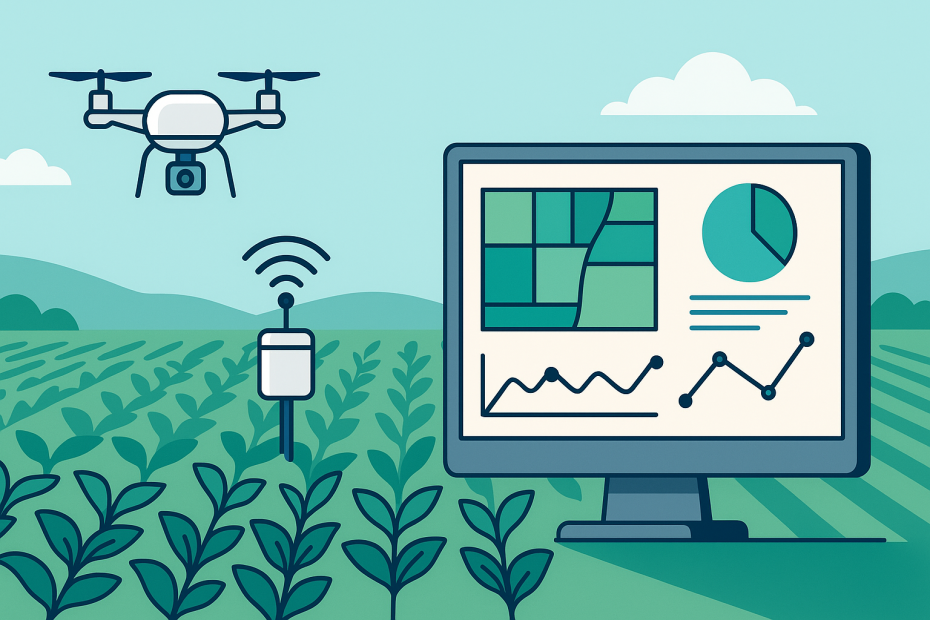
AI integrates multiple data sources—satellite imagery, drone scans, IoT sensors, and weather feeds—to guide input application. You can manage resources with surgical precision.
For example, variable-rate fertilization powered by AI ensures crops only get nutrients where needed. Irrigation systems tied to soil moisture sensors and AI forecasts deliver water exactly when and where it counts. Machine learning models detect plant stress before it becomes visible, allowing timely pest or disease control.
With these systems in place, you not only boost yields but also cut back on resource costs. The technology shifts you from reactive farming to proactive optimization—every season becomes more predictable and efficient.
Can smallholder farmers benefit from AI tools?
Yes. Even if you run a small farm, AI tools are increasingly built for affordability and accessibility. Mobile-based platforms bring AI into your daily decision-making without requiring heavy infrastructure.
In Kenya, a farmer named Sammy Selim used an AI tool called Virtual Agronomist and nearly tripled his coffee yield by following its advice on fertilizer and pest timing. In India and Ethiopia, voice-based chatbots now guide thousands of smallholders through crop choices, irrigation schedules, and market updates. These tools rely on mobile phones and regional language support, making them practical for limited-resource farmers.
You gain tailored recommendations without needing a team of agronomists on site. This levels the playing field, making AI farming not just a large-scale solution but one that strengthens food security in rural areas worldwide.
What about AI adoption in India?
India demonstrates how AI adoption can transform yield and reduce costs simultaneously. Farmers in Khutbav village using Microsoft’s AI platform increased yields by 40% while lowering production costs by 50%. That combination of higher output and lower expense changes long-term profitability dramatically.
Another pilot in Vidarbha applied AI to sugarcane farming. The result: 140 tonnes per acre yield, far above traditional averages. When scaled across clusters of farms, these improvements provide a competitive edge in global commodity markets.
The Indian example shows that you don’t need to reinvent the wheel. By applying AI farming tools already tested in the field, you can achieve real cost efficiency and harvest growth at the same time.
How do autonomous and robotic tools help?
Autonomous tractors, drones, and greenhouse management systems powered by AI enhance both labor efficiency and yield optimization. You reduce dependence on human labor while achieving greater precision.
Autonomous tractors are now being tested in vineyards and large row-crop farms. They operate with less fuel, less downtime, and more consistent accuracy compared to manual operation. Drone fleets handle pest spraying, seed distribution, and crop monitoring far faster than a workforce can. In greenhouses, AI-driven climate and nutrient controls fine-tune growth conditions daily.
Each of these systems takes repetitive, high-risk, or labor-heavy tasks and converts them into predictable, automated functions. For you, that means more hours spent on strategy, less on manual execution, and ultimately better harvest outcomes.
How accurate are AI-based yield predictions?
AI models today forecast yields with more than 90% accuracy when trained with quality data. That accuracy allows you to plan finances, labor, and logistics with confidence.
Yield prediction tools integrate decades of weather records, satellite imagery, and historical harvest performance. They can simulate different fertilizer or planting strategies before you commit resources. With this foresight, you minimize guesswork and reduce exposure to risk.
The payoff isn’t just in the field. Better yield forecasts translate into smarter contracts, stronger bargaining power, and optimized market timing. Knowing your numbers in advance keeps your business ahead of the curve.
What are the limits and challenges of AI farming?
The biggest hurdles to AI adoption are high equipment costs, limited rural connectivity, and lack of training. If your farm lacks strong internet access, you can’t maximize the benefits of cloud-based AI.
Another barrier is affordability. While large farms justify autonomous tractors or satellite-linked tools, smaller operations often find upfront costs prohibitive. In the United States, only 25% of farms use precision agriculture tools consistently—proof that access remains uneven.
Finally, AI tools still require informed operators. You must understand how to interpret dashboards, troubleshoot devices, and integrate recommendations into practice. Without training, expensive tools risk being underused or misapplied.
Benefits of Smart Agriculture Technology
When you adopt AI-powered farming, the benefits go beyond higher yields.
- Input efficiency – Reduce water, fertilizer, and pesticide use without lowering yields.
- Profit gains – Increase margins through higher production and cost reduction.
- Environmental protection – Lower runoff, conserve water, and reduce emissions.
- Labor optimization – Free your team from repetitive tasks through automation.
Each benefit compounds over seasons. You build not just one good harvest, but a system of continuous performance improvement.
How Generative AI and Big Data Add Value
Generative AI expands the role of technology from tactical to strategic. You use it to test different planting patterns, simulate market scenarios, and optimize entire supply chains.
For example, generative AI can run models that determine the best planting time based on current weather forecasts and market demand cycles. Paired with big data, you can spot trends in soil fertility or disease outbreaks across regions, giving you advance notice before local problems emerge.
This means your farm isn’t only reacting to local data. It’s part of a global information network that helps you plan smarter and stay resilient against external shocks like weather volatility or labor shortages.
Implementing Smart Farming—Focus Areas
If you’re starting with AI farming, prioritize tools that bring immediate ROI. Soil moisture sensors, aerial drones, and mobile-based AI apps are practical entry points.
As adoption grows, focus on extension networks and AI-driven chatbots. They connect you with expertise and help scale knowledge across your workforce. Track your results closely. Measure yield per acre, input savings, and profit shifts. These metrics give you the evidence you need to expand adoption.
Finally, advocate for stronger rural infrastructure. Reliable internet and power supply are the backbone of AI farming. Without them, scaling up remains difficult. By aligning with cooperatives, policymakers, and agritech providers, you strengthen both your farm and your region’s agricultural competitiveness.
Key AI Farming Benefits at a Glance
- Boost yields by 20–50% with AI-driven precision farming.
- Save water, fertilizer, and labor through automation.
- Achieve yield predictions with 90%+ accuracy for planning.
In Conclusion
You gain measurable productivity, efficiency, and sustainability when you adopt AI on the farm. By starting small with accessible tools, building data into decisions, and scaling gradually, you unlock yield gains that competitors can’t match. Smart farming is no longer optional—it’s the edge you need to thrive in agriculture today.

Dax Cooke is the founder of Farmfolio, a Medellín-based agribusiness and farmland development company. With 10+ years across capital markets and agribusiness, he builds sustainable, cash-flowing farmland projects and export supply chains (coconut, lime, teak, avocado). A three-time NAIFA 40 Under 40 honoree, his career began at Citigroup’s Capital Markets.