
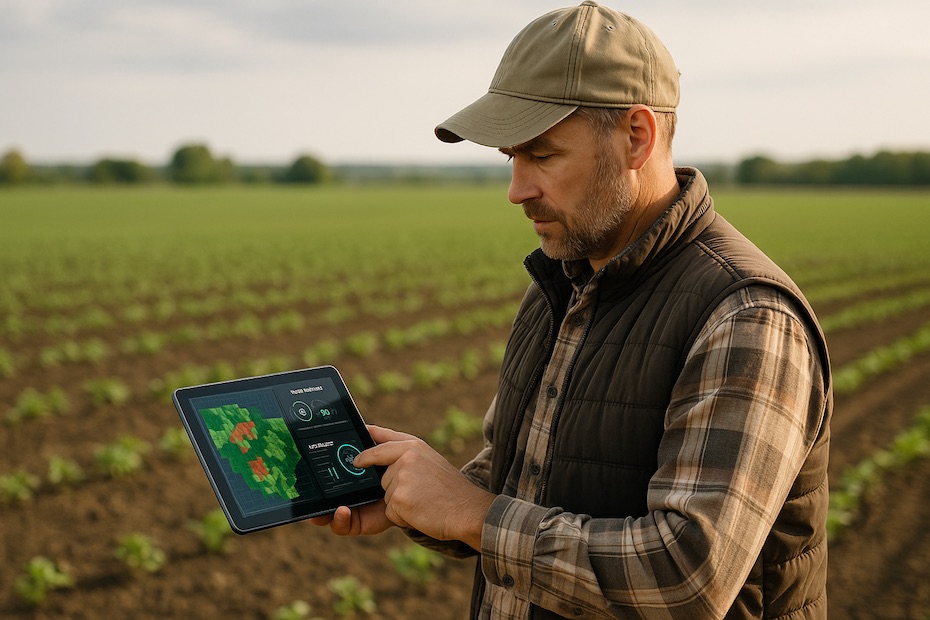
You can restore soil health and boost profitability by using high-tech tools designed for regenerative agriculture.
This article explains how advanced sensors, AI platforms, and precision systems make regenerative farming measurable, efficient, and profitable. You’ll learn how to use these innovations to track progress, verify outcomes, and position your farm for long-term growth.
What Is Regenerative Agriculture and Why Does High-Tech Matter?
Regenerative agriculture focuses on rebuilding soil organic matter, improving biodiversity, and enhancing the land’s long-term productivity. Traditional practices like cover cropping, crop rotation, and reduced tillage remain the foundation. But as you’ve likely seen, today’s operations demand more precision than manual observation can deliver.
That’s where regenerative agriculture technology comes in. Sensors, satellites, and data analytics turn soil management into a measurable system rather than an intuition-based art. They track moisture levels, soil organic carbon, microbial activity, and nutrient availability in real time. This gives you clear feedback on what’s working—and what isn’t—so you can make immediate adjustments.
Farmers using these tools report 10–20% lower input costs and improved yield resilience, particularly under drought stress. When paired with regenerative methods, technology doesn’t just restore soil—it restores profit margins.
How Do Soil Sensors and Data Platforms Support Regenerative Practices?
Soil sensors are your foundation for data-driven regeneration. They monitor moisture, temperature, electrical conductivity, and sometimes microbial respiration. This continuous flow of information allows you to optimize irrigation schedules, prevent overwatering, and improve nutrient efficiency.
For example, Dutch farmers using Sensoterra wireless sensors have reduced irrigation by 30% while maintaining or improving yields. These devices communicate with cloud-based dashboards, giving you live field conditions accessible from any device. Paired with predictive weather data, you can plan operations to minimize erosion and runoff.
Digital platforms such as Farm21, CropX, and Arable aggregate data from multiple sources—satellites, weather stations, and soil probes. They generate field-specific recommendations on when to seed cover crops, how much to irrigate, and when to rest the soil. Over time, this creates a digital record of soil health recovery—critical for proving regenerative claims to buyers or investors.
What High-Tech Tools Can You Use to Monitor and Verify Soil Health?
Verifying soil regeneration requires precision tools that can measure change over time. The latest options combine AI modeling with field data to make verification scalable and affordable.
You can deploy satellite and drone imagery to analyze vegetation cover, soil moisture, and erosion risk across your acreage. These visuals help you evaluate which areas are recovering faster and which need intervention. Platforms like PlanetScope and DroneDeploy now integrate machine learning to detect subtle improvements in canopy cover and biomass.
AI-powered soil analytics—offered by companies such as Perennial and Boomitra—can estimate soil organic carbon (SOC) based on minimal sampling data. These models cut verification costs by up to 70%. Combined with on-the-ground sensors, they allow you to verify regenerative outcomes for carbon-credit programs or premium buyers demanding proof of sustainability.
You might integrate:
- Soil moisture and EC sensors at different depths
- Satellite data to track ground cover and plant vigor
- Machine-learning models to estimate carbon sequestration
- Field platforms that consolidate soil and weather analytics
Together, these systems create a continuous feedback loop—measure, adjust, improve—that drives long-term soil health and profitability.
How Do High-Tech Tools Improve Profitability in Regenerative Systems?
Profitability in regenerative agriculture often hinges on efficiency and market differentiation. Precision technology lets you do both.
You reduce costs by applying inputs only when and where they’re needed. AI irrigation systems can save up to 25% of water and fertilizer use by targeting the root zone directly. Automated nutrient modeling ensures balanced soil fertility, reducing chemical dependency and costs.
Technology also enhances resilience. By monitoring soil moisture and root health, you can respond before stress affects yield. Farmers using predictive analytics during 2024’s European heatwaves reported 12% higher yields than neighbors relying on traditional schedules.
Additionally, digital verification unlocks premium opportunities. Data-backed regenerative claims command higher prices from food brands, processors, and investors who require proof of sustainability. Verified carbon credits and regenerative certifications provide new income streams.
Key economic advantages include:
- Lower fertilizer and water inputs
- More stable yields under weather variability
- Verified sustainability premiums and carbon credits
- Better long-term asset value of land
This blend of ecological integrity and financial gain is how technology turns regeneration into a measurable business model.
How Can You Start Integrating Technology Into Regenerative Agriculture?
You start by establishing your baseline. Conduct a soil test for organic matter, carbon, pH, and nutrient balance. Use this as your benchmark for tracking improvements. Then, identify one manageable zone to pilot your technology.
Install soil sensors in key zones, connect them to a digital dashboard, and gather data for at least one full season. Add satellite or drone mapping to monitor vegetation and soil moisture patterns. From there, layer on advanced tools—AI forecasting, decision-support platforms, and verification systems.
Over time, expand coverage across the entire operation. Integrate weather data and predictive irrigation to fine-tune inputs. Many farmers find value in starting with modular tools rather than all-in-one systems. This lets you scale based on what delivers measurable returns.
Practical steps include:
- Establish soil-health benchmarks
- Choose affordable, modular tech solutions
- Train staff in data interpretation
- Use results to refine regenerative management plans
Technology should enhance—not complicate—your regenerative strategy. Keep the process results-focused and measurable from day one.
What Pitfalls Should You Avoid When Using Tech for Regenerative Agriculture?
The most common pitfall is assuming technology replaces good agronomic judgment. It doesn’t. Data is only valuable when you act on it. Without management discipline, even the best AI platform becomes an expensive dashboard.
Avoid collecting data without building decision systems. Set clear goals: What will you do when moisture drops below a threshold? Who interprets alerts and makes changes? Successful regenerative programs tie every data point to a management action.
Another pitfall is over-investing early. Many tools promise advanced analytics but require time and training to use effectively. Start small, prove ROI, and scale deliberately. Ensure you own your data—some providers use aggregated data for external modeling, which may limit your control over verification claims.
Lastly, don’t neglect human capital. The technology’s real power comes from a team that understands how to interpret it. Train your agronomists, equipment operators, and managers to treat data as a daily tool, not a novelty.
How Should You Measure Success in a High-Tech Regenerative Program?
Success isn’t just higher yields—it’s measurable soil recovery combined with consistent profitability. Track quantitative metrics that align with your farm’s performance goals.
Soil organic matter (SOM) and SOC gains remain the gold standards. Aim for an annual SOC increase of 0.2–0.4 tons per hectare. Monitor water-use efficiency, input costs, and yield stability over time. Each metric tells you whether regeneration is translating into resilience.
Complement agronomic indicators with financial KPIs—input costs per hectare, return on investment per technology type, and gross margin improvements. Use digital dashboards to visualize data over time so you can make evidence-based adjustments.
Target indicators to monitor:
- Soil organic matter and carbon levels
- Water-use efficiency (liters per hectare)
- Input-cost reduction (%)
- Yield variance under stress conditions
- Verified carbon or sustainability credits earned
These metrics keep you accountable and demonstrate measurable progress to buyers, investors, and partners.
What tech tools help regenerative agriculture restore soil and profits?
- Soil and moisture sensors for root-zone monitoring
- AI soil-carbon modeling and digital mapping
- Satellite and drone imaging for ground-cover analysis
- Data platforms integrating soil, weather, and crop metrics
The Future Is Measurable—And Profitable
Regenerative agriculture no longer relies solely on faith in nature—it thrives on measurable data. By combining technology with soil restoration practices, you create a self-improving system that rewards both the land and your bottom line. With each season, your soil becomes richer, your costs lower, and your operation more resilient against market and climate volatility.
If you’re ready to see how high-tech farming can rebuild your land and your revenue, connect with me for more expert insights on modern ag innovation and regenerative profitability — visit my website to continue the conversation and explore future-focused resources.

Dax Cooke is the founder of Farmfolio, a Medellín-based agribusiness and farmland development company. With 10+ years across capital markets and agribusiness, he builds sustainable, cash-flowing farmland projects and export supply chains (coconut, lime, teak, avocado). A three-time NAIFA 40 Under 40 honoree, his career began at Citigroup’s Capital Markets.