
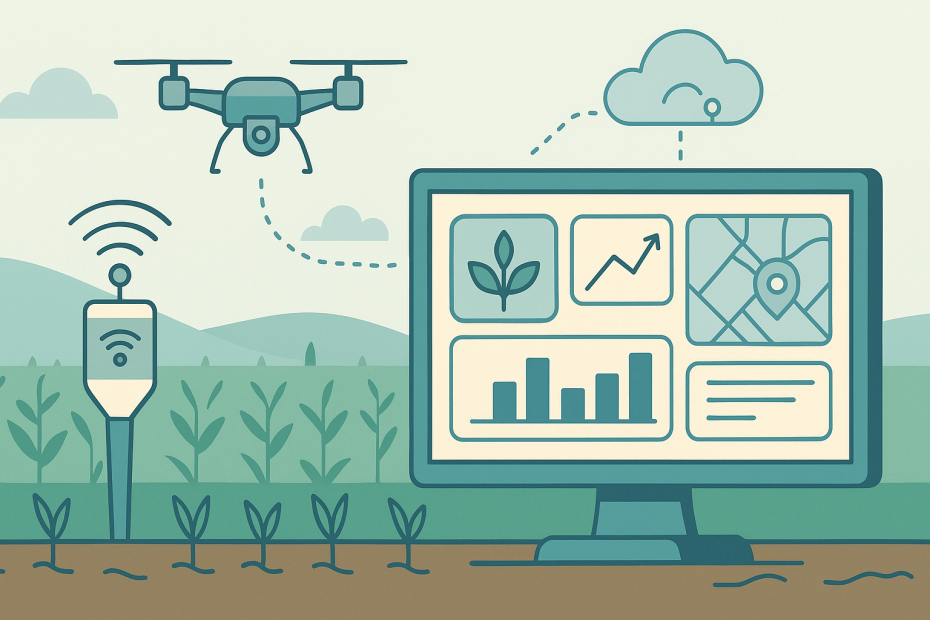
You increase efficiency and profitability in agribusiness by using digital farming systems that collect, analyze, and act on real-time data to guide every decision.
This article explores how digital farming transforms modern agribusiness. You’ll see what digital farming means, how it works, which tools drive results, barriers to adoption, and real-world outcomes you can model.
What is digital farming and how does it differ from precision agriculture?
Digital farming refers to the use of integrated digital platforms that manage data across your entire value chain—spanning soil, weather, crop growth, logistics, and market intelligence. Precision agriculture, while important, focuses mainly on applying technology within the field for seeding, spraying, and irrigation.
In digital farming, the scope expands. You can track a shipment from your warehouse to the distributor, tie it back to production data, and adjust your planning accordingly. This creates a continuous feedback loop—not just about what happens in the field but also about how your product performs in the market.
The value is that digital farming positions your agribusiness to be predictive rather than reactive. You get the tools to manage variables before they create losses.
How effective is digital farming for improving production and reducing waste?
Digital farming delivers significant efficiency. According to the World Bank, farms that adopt digital systems increase yields, cut operating costs, reduce emissions, and open new market channels.
Waste reduction is another measurable outcome. By using sensors and analytics, you apply water and fertilizer precisely where needed. That cuts runoff, preserves soil health, and saves money on inputs. Similarly, supply chain monitoring helps reduce post-harvest waste by tracking storage conditions and logistics performance in real time.
You benefit from both ends of the chain—higher productivity and lower losses. These gains compound season after season, creating a stronger long-term return.
What technologies actually enable digital farming?
Digital farming is not one technology—it’s a layered system. You gain the most when these layers work together:
- IoT devices: Soil sensors, drones, and GPS equipment collect continuous field data.
- Farm Management Information Systems (FMIS): These unify mapping, yield forecasting, accounting, and equipment tracking into a single platform.
- Analytics and machine learning: Algorithms interpret vast data sets to guide your next action, from spraying decisions to logistics planning.
- Satellite imaging and remote sensing: Provide macro-level data on crop health, climate shifts, and regional trends.
Each tool on its own delivers value, but when combined, you gain full operational control. You move from managing silos of data to running your agribusiness on unified intelligence.
Why are agribusiness leaders implementing digital farming now?
Global competition, climate volatility, and rising input costs are forcing you to adopt smarter systems. Relying only on experience is no longer enough—today’s margins depend on real-time, data-driven decisions.
With digital farming, you optimize irrigation schedules, fertilizer application, and pest control with precise timing. Instead of guessing market demand, you align production and logistics with predictive analytics. Traceability, now demanded by global buyers, becomes easier when every step is digitally recorded.
The result is sharper profitability and stronger market access. You gain resilience by eliminating guesswork and grounding your decisions in live data.
What barriers do you face when scaling digital agriculture?
Scaling digital farming comes with challenges, especially for mid-size and smaller operations.
- High costs: Sensors, software licenses, and analytics platforms require upfront investment.
- Connectivity gaps: Without reliable internet in rural zones, real-time monitoring is limited.
- Training needs: Data is only valuable if your team understands how to interpret and act on it.
- Adoption rates: Younger and larger-scale farmers adopt faster, while smaller farms often hesitate without incentives.
You must weigh these challenges against the proven benefits. Partnerships with cooperatives, government-backed programs, and agritech vendors can lower the barriers. Overcoming these hurdles positions you ahead of competitors slower to adopt.
How can you implement digital farming—what steps yield real results?
Implementing digital farming requires deliberate planning. You shouldn’t overwhelm your team with a full rollout all at once. Instead, follow a phased strategy:
- Audit operations to identify inefficiencies and gaps.
- Define measurable goals such as reducing fertilizer use by 20% or improving harvest forecasting accuracy.
- Start with modular tools like soil sensors, FMIS software, or drone imaging.
- Integrate systems into a single dashboard for oversight.
- Train your workforce to interpret reports and make data-driven choices.
- Expand gradually by layering in more advanced technologies.
- Monitor metrics consistently to validate ROI.
This measured path ensures adoption is sustainable and results are demonstrable.
What real-world outcomes demonstrate the power of digital farming?
You don’t need to look far for proof.
In Kenya, farmers using AI-powered agronomy tools nearly tripled their coffee yields. In India, pilot projects in sugarcane achieved 140 tonnes per acre with digital guidance. In Argentina, precision and digital farming practices raised productivity by 54%.
Supply chain examples are equally compelling. Agribusinesses using FMIS platforms report sharper traceability, reduced post-harvest waste, and improved compliance with global buyers. These aren’t theoretical gains—they’re real results that mirror what you can achieve.
How accurate are digital farming predictions for yields and markets?
Yield prediction models now achieve over 90% accuracy in some regions when fed with robust satellite, soil, and weather data. That level of precision helps you allocate resources with confidence.
Market prediction models track demand cycles and pricing trends across regions. By integrating this with your farm-level data, you align harvest planning and logistics with real-world demand.
The result is fewer mismatches between what you produce and what markets actually need. That translates into reduced waste and stronger profit margins.
Essential Facts About Digital Farming
- Uses IoT sensors, FMIS, and analytics for real-time control.
- Boosts yields and cuts costs through precision.
- Improves traceability and market access with digital records.
In Conclusion
You strengthen yields, margins, and sustainability when you embrace digital farming. By layering IoT devices, FMIS, and predictive analytics, you move from reactive farming to proactive agribusiness management. Start with focused interventions, expand strategically, and measure outcomes—you’ll build an operation that thrives on data-driven decisions.

Dax Cooke is the founder of Farmfolio, a Medellín-based agribusiness and farmland development company. With 10+ years across capital markets and agribusiness, he builds sustainable, cash-flowing farmland projects and export supply chains (coconut, lime, teak, avocado). A three-time NAIFA 40 Under 40 honoree, his career began at Citigroup’s Capital Markets.